Sharpa Wave 01#
embodichain.extensions.robots.SharpaWaveCfg configures a standalone left or right
Sharpa Wave 01. The robot catalog ID is SharpaWave; left and right select the
native models, with right as the default.
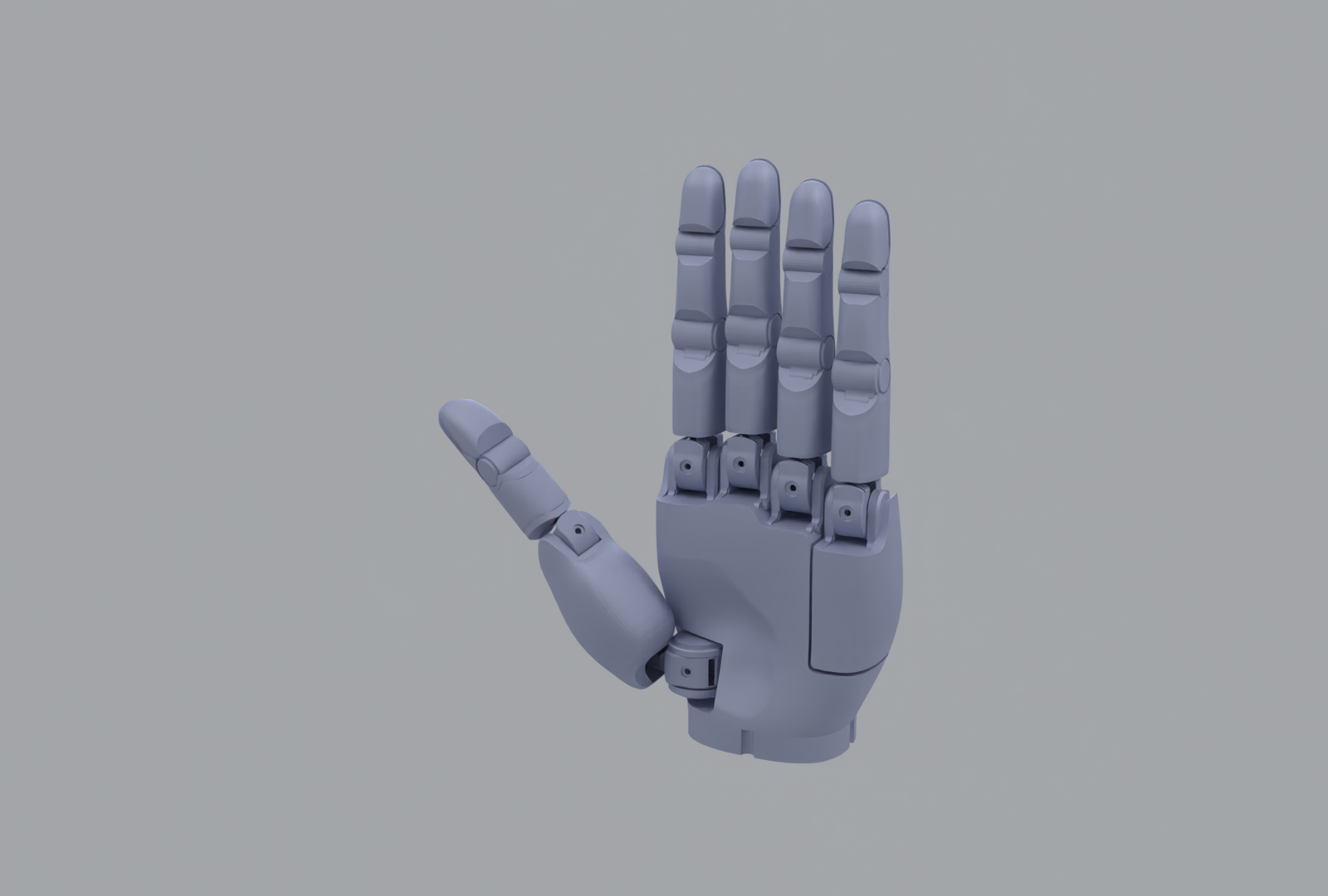
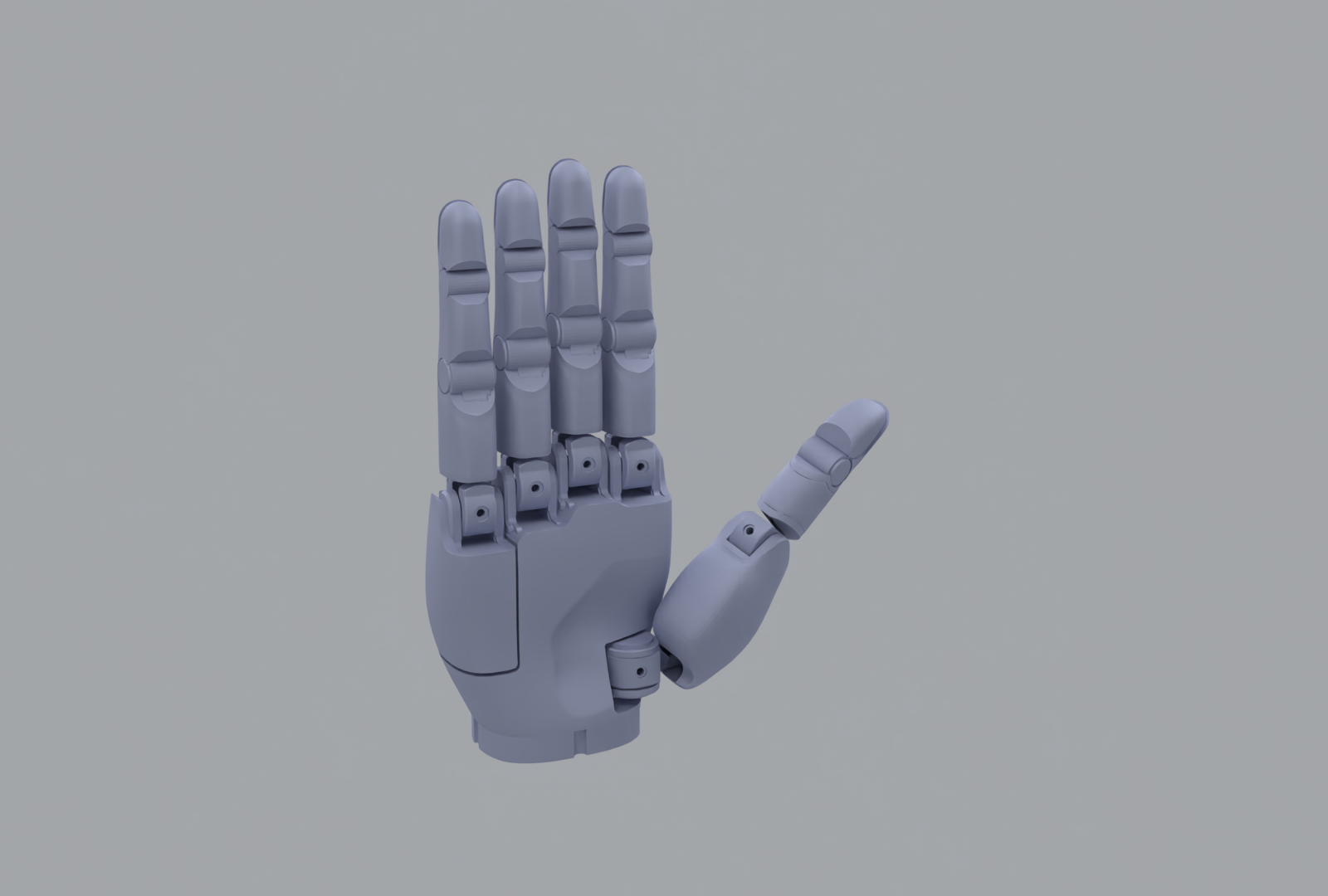
The illustrations render the published visual geometry and authored materials in native OfflineRT, at the preset’s initial joint coordinates and a presentation root transform. No physics steps or visual-mesh/material replacements are used. Each manifest records the display lighting (environment intensity 40, half-intensity studio lights placed outside the camera view), camera and source/image hashes. See EEF rendering conventions.
Construct, discover and preview#
Given an existing SimulationManager named sim:
from embodichain.robot_registry import resolve_robot_cfg
from embodichain.extensions.robots import SharpaWaveCfg

cfg = resolve_robot_cfg("SharpaWave", variant="left")
# Equivalent model-local selection:
cfg = SharpaWaveCfg.from_dict({"side": "left"})
restored = SharpaWaveCfg.from_dict(cfg.to_dict())
robot = sim.add_robot(cfg=restored)
embodichain list-robot
embodichain preview-robot --robot SharpaWave --variant left --viser
embodichain preview-robot --robot SharpaWave --variant right --viser
embodichain preview-robot --robot SharpaWave --variant right --headless --device cpu --renderer no-render --physics default --max-steps 100
The model package also lazily exports SharpaWaveCfg from
embodichain.extensions.robots.sharpa.wave. Listing catalogs does not
import configurations or download assets. Unsupported sides fail before asset
lookup. from_dict() builds defaults and applies isolated overrides through the
standard RobotCfg path. An existing local fpath bypasses asset download.
Caller-defined control-group names are retained.
Control contract#
eef commands all 22 independent revolute joints, in radians.
Source order is thumb (CMC_FE, CMC_AA, MCP_FE, MCP_AA, IP), then index,
middle and ring (MCP_FE, MCP_AA, PIP, DIP each), then pinky
(CMC, MCP_FE, MCP_AA, PIP, DIP). Names retain their left_ / right_ prefix.
There are no mimic followers. All 22 joints start at zero, within their source position limits.
q = robot.get_qpos(name="eef").clone()
robot.set_qpos(q + 0.08, name="eef")
# Advance the simulator to execute the position command.
sim.update(step=100)
robot.reset()
solver_cfg and build_pk_serial_chain() are empty. The hand is a branched
articulation: no finger IK, single tool TCP, open/close service, grasping policy,
retargeting or tactile simulation is implied. Catalog metadata declares
dexterous_hand, zero arms and no generic dual-arm base compatibility.
Physical defaults#
The palm is fixed to the world at (0, 0, 0.3) metres with the source orientation.
This root placement clears the standalone ground and is not a calibrated mount.
Self-collision is disabled by the generic root defaults; callers can explicitly
configure it for their application. Native joint/link names, position, effort
and velocity limits, masses, COMs and inertias remain source-owned.
Force-drive stiffness 3 N·m/rad and damping 0.1 N·m·s/rad are initial simulation PD defaults, not measured motor gains or hardware calibration. Source effort/velocity limits and link inertials are explicitly reapplied through portable drive/link fields because native importer defaults can otherwise replace them. These overlays reproduce source values without retuning the physical model. Caller configuration can replace the gains and physical defaults. Validation covers Default-backend CPU spawn, joint commands and reset for both sides; it does not qualify contact-rich manipulation or other physics backends.
Assets and provenance#
from embodichain.data import get_data_path
from embodichain.extensions.robots.sharpa.wave.assets import SharpaWave

right_urdf = get_data_path("SharpaWave/right_sharpa_wave/right_sharpa_wave.urdf")
The published V1 archive
contains both sides and uses the SharpaWaveV1 cache. Source:
sharpa-robotics/sharpa-urdf-usd-xml at 0d19cac602f4.
The model-owned provenance record
records licensing, preparation, archive hashes and native MJCF resources.
Host assemblies own mount transforms, naming prefixes and task-specific interfaces.