AgileX Pika Gripper#
The official AgileX SDK supports Pika Gripper. The archive records preparation from a local pika_ros package named pika_gripper_description, including relative mesh paths, normalized attachment frames and a mimic jaw. A public upstream commit and original asset author remain unverified.
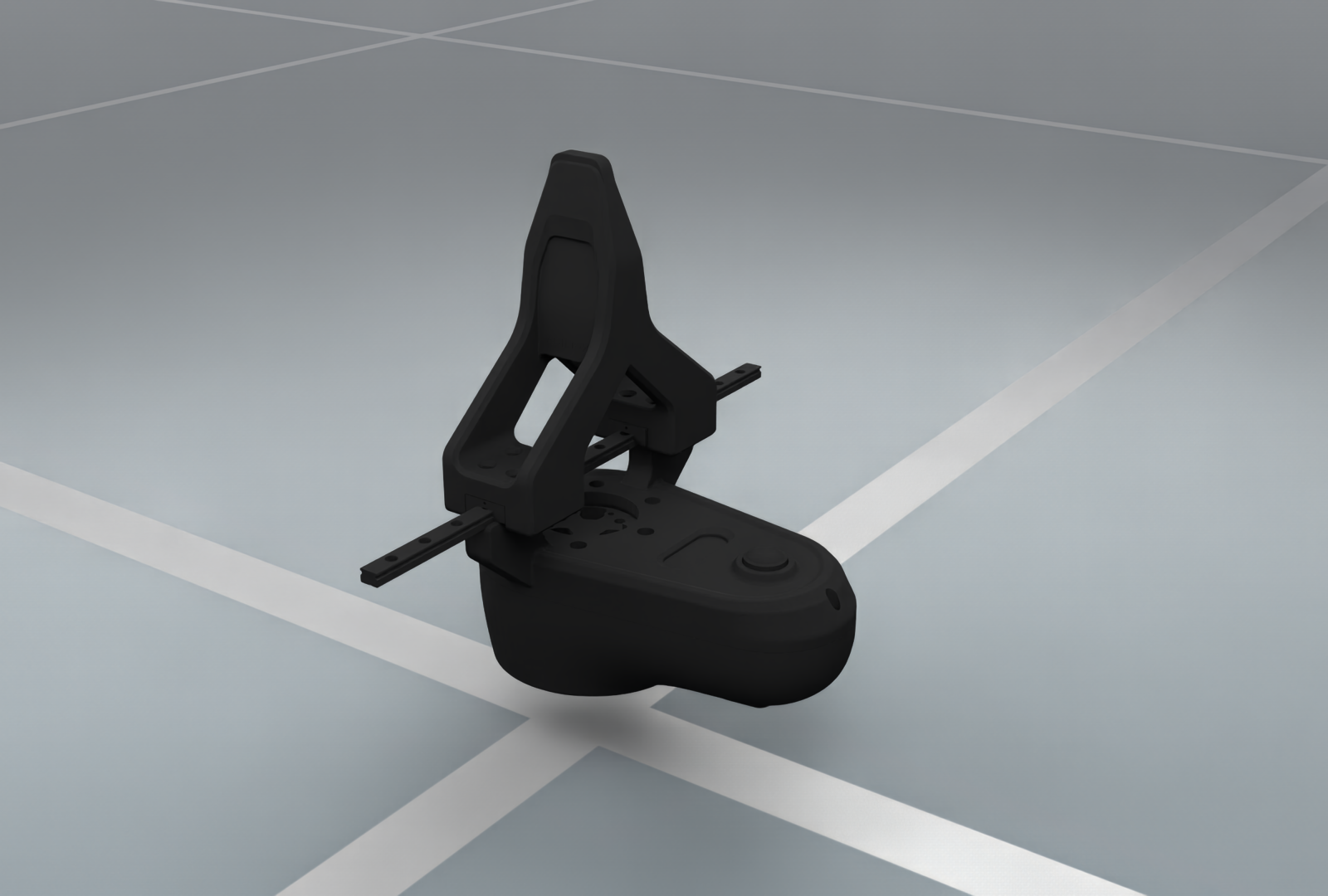
The images use the archive’s visual meshes and authored materials in native OfflineRT. They show a zero-coordinate display pose with a presentation root transform, without stepping physics. Rendering settings and the source URDF checksum are recorded per image. See EEF rendering conventions.
Resolve and preview#
Canonical download-class import:
from embodichain_robots.agilex.pika.assets import PikaGripper
Use the stable asset reference for normal loading:
from embodichain.data import get_data_path

urdf_path = get_data_path("PikaGripper/PikaGripper.urdf")
embodichain data download --name PikaGripper
embodichain preview-asset --asset_path /absolute/path/to/pika-display/PikaGripper.urdf --viser
For this asset, the native standalone loader requires the caller-owned display
copy described below. Pass that copy to preview-asset. Asset listing and
class lookup do not download the archive; resolving its files may download on
first use. The remaining source models in this archive are listed in the image
captions above.
Standalone display preparation#
The current native Default importer rejects the source root’s explicit zero
mass/inertia. This does not change the stable archive or the mounted W1/Pika
assembly. The illustration uses a temporary display URDF with inertials removed
from the two empty fixed frames, GRIPPER_ROOT_LINK and ADAPTER_LINK.
Visual meshes, their transforms, materials and joint geometry are unchanged;
mesh references resolve through a symlink to the original extracted files.
The manifest records this preparation separately from the original URDF hash.
To reproduce a display copy outside the shared cache:
from pathlib import Path
import xml.etree.ElementTree as ET
from embodichain.data import get_data_path

source = Path(get_data_path("PikaGripper/PikaGripper.urdf"))
display = Path("pika-display")
display.mkdir(exist_ok=True)
if not (display / "meshes").exists():
    (display / "meshes").symlink_to(source.parent / "meshes", target_is_directory=True)
tree = ET.parse(source)
for name in ("GRIPPER_ROOT_LINK", "ADAPTER_LINK"):
    link = tree.find(f"link[@name='{name}']")
    link.remove(link.find("inertial"))
tree.write(display / "PikaGripper.urdf")
This is a visual-only preparation, not calibrated physical data or a replacement
simulation preset. The existing dexforce_w1_030_pika embodiment owns mounted
simulation, tool drives and TCP calibration.
Attachment and jaw coordinates#
Mount through GRIPPER_ROOT_LINK. FINGER1_JOINT is the independent prismatic
jaw coordinate over 0–0.05 m, closed to open; FINGER2_JOINT mimics it.
The archive separates DAE visual meshes from STL collision meshes. W1/Pika
mounts, TCPs and drives remain in the existing task embodiment rather than a
new Pika-specific W1 catalog variant.
Ownership and provenance#
The download class lives in extensions/embodichain_robots/agilex/pika/assets.py and registers through the
existing embodichain.assets catalog with category eef. This asset-only
package does not introduce a standalone robot preset. Host assembly owns the
mounting transform, naming prefix, control-group mapping and task-specific TCP.
The asset provenance record separately records manufacturer affiliation, model matching, asset production, archive distribution, modifications and license status. Missing upstream or license evidence stays explicitly unverified. The Python implementation’s Apache header is not an asset license statement.