EmbodiChain#
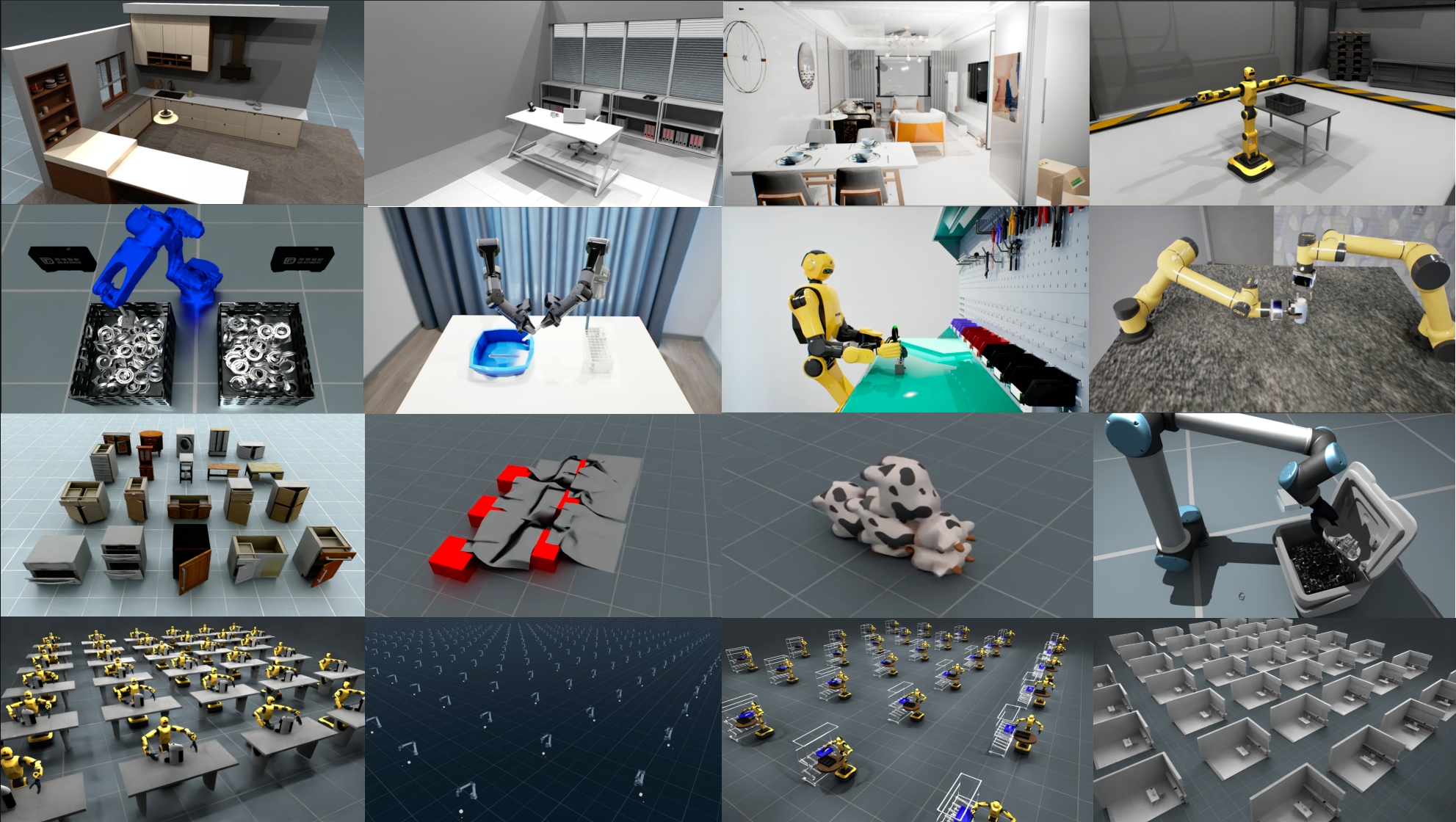
EmbodiChain is an end-to-end, GPU-accelerated framework for Embodied AI. It streamlines research and development by unifying high-performance simulation, automated generative data pipelines, modular model architectures, and efficient training workflows. This integration enables rapid experimentation, seamless deployment of intelligent agents, and effective Sim2Real transfer for real-world robotic systems.
Official task and robot modules live under
extensions/ and ship with the main
distribution. Their Python imports remain embodichain_tasks and
embodichain_robots.
Note
EmbodiChain is in Alpha and under active development: * More features will be continually added in the coming months. You can find more details in the roadmap. * Since this is an early release, we welcome feedback (bug reports, feature requests, etc.) via GitHub Issues.
Key Features#
🚀 High-Fidelity GPU Simulation: Realistic physics for rigid & deformable objects, advanced ray-traced sensors, all GPU-accelerated for high-throughput batch simulation.
🤖 Unified Robot Learning Environment: Standardized interfaces for Imitation Learning, Reinforcement Learning, and more.
📊 Scalable Data Pipeline: Automated data collection, efficient processing, and large-scale generation for model training.
⚡ Efficient Training & Evaluation: Online data streaming, parallel environment rollouts, and modern training paradigms.
🧩 Modular & Extensible: Easily integrate new robots, environments, and learning algorithms.
The figure below illustrates the overall architecture of EmbodiChain:
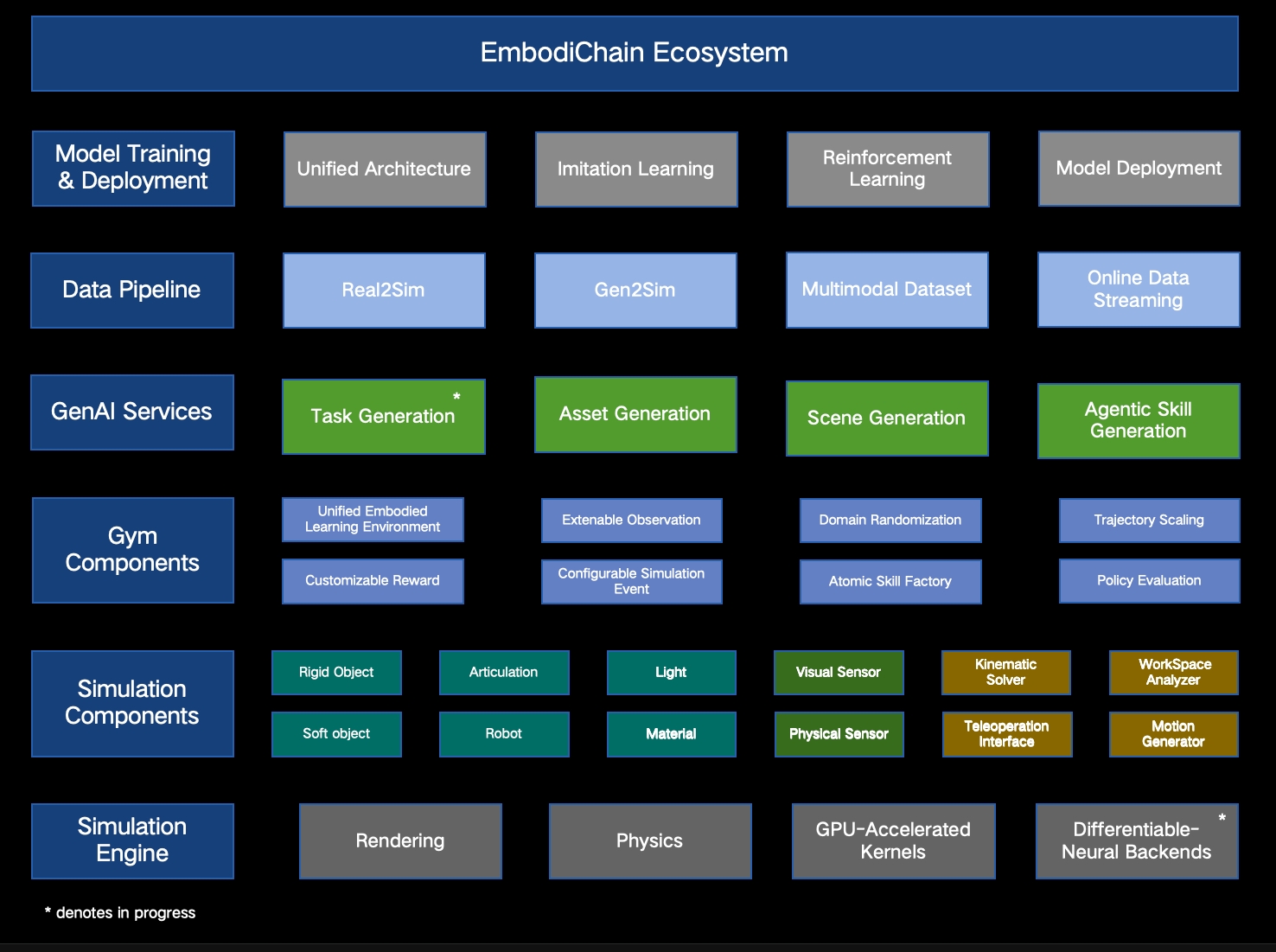
Explore EmbodiChain’s module relationships with the interactive architecture visualization.
Getting Started#
To get started with EmbodiChain, follow these steps:
Task Environments#
Official task environments are included in the main embodichain
installation. Use embodichain list-task to discover tasks and
embodichain run-task to launch one with its configuration. See
Supported
Tasks
for available tasks, runnable configurations, and task authoring guides.
For external training, see the optional RLinf integration and the official RLinf EmbodiChain recipe.
Contribution Guide#
We welcome contributions! Please see the CONTRIBUTING.md file in this repository for guidelines on how to get started.
Publications#
See Academic Publications for a complete list of academic papers related to EmbodiChain.
Citation#
If you find EmbodiChain helpful for your research, please consider citing our work:
@misc{EmbodiChain,
  author = {EmbodiChain Developers},
  title = {EmbodiChain: An end-to-end, GPU-accelerated, and modular platform for building generalized Embodied Intelligence},
  month = {November},
  year = {2025},
  url = {https://github.com/DexForce/EmbodiChain}
}
@misc{GS-World,
   author = {Guiliang Liu and Yueci Deng and Zhen Liu and Kui Jia},
   title = {GS-World: An Efficient, Engine-driven Learning Paradigm for Pursuing Embodied Intelligence using World
      Models of Generative Simulation},
   month = {October},
   year = {2025},
   journal = {TechRxiv}
}