Policy Evaluation#
embodichain eval-policy evaluates a saved EmbodiChain policy after training.
It reconstructs the policy and environment from the training configuration,
loads the selected checkpoint, and writes a standalone evaluation report.
The command runs Headless by default. Add --viewer to open the original
simulator task in the DexSim Viewer.
Training output#
train-rl records the files required by a later evaluation:
outputs/<experiment>_<timestamp>/
├── checkpoints/
│   └── policy_*.pt
├── configs/
│   ├── train.yaml
│   └── gym.yaml
├── logs/
├── videos/
│   ├── train/
│   └── eval/
└── run-manifest.json
configs/gym.yaml is present for simulator tasks. The first evaluation adds:
evaluations/
└── <timestamp>-policy/
    └── evaluation.json
run-manifest.json connects the run directory to its configuration snapshots
and checkpoints:
{
  "schema_version": 1,
  "configs": {
    "train": "configs/train.yaml",
    "gym": "configs/gym.yaml"
  },
  "checkpoints": {
    "best": "checkpoints/cart_pole_grpo_best.pt",
    "latest": "checkpoints/cart_pole_grpo_step_4096.pt"
  }
}
All paths in the manifest are relative to the run directory. best is null
when training did not select a best checkpoint.
Evaluate a training run#
The shortest command selects latest and runs the configured number of
Headless evaluation episodes:
embodichain eval-policy outputs/<experiment>_<timestamp>
Select the best checkpoint and override the episode count:
embodichain eval-policy outputs/<experiment>_<timestamp> \
  --checkpoint best \
  --episodes 10
Open the original simulator task in the Viewer:
embodichain eval-policy outputs/<experiment>_<timestamp> \
  --checkpoint best \
  --viewer \
  --renderer hybrid \
  --device cuda:0 \
  --sim-device gpu
The Viewer uses one environment and keeps running until the window closes. Use
--episodes, --control-steps, or --duration to select another stopping
condition. --renderer accepts hybrid, fast-rt, and rt.
Tasks exposing set_velocity_command() and velocity_command_bounds() also
accept --command vx vy yaw_rate; use --keymap wasd or --keymap arrows
for interactive command changes.
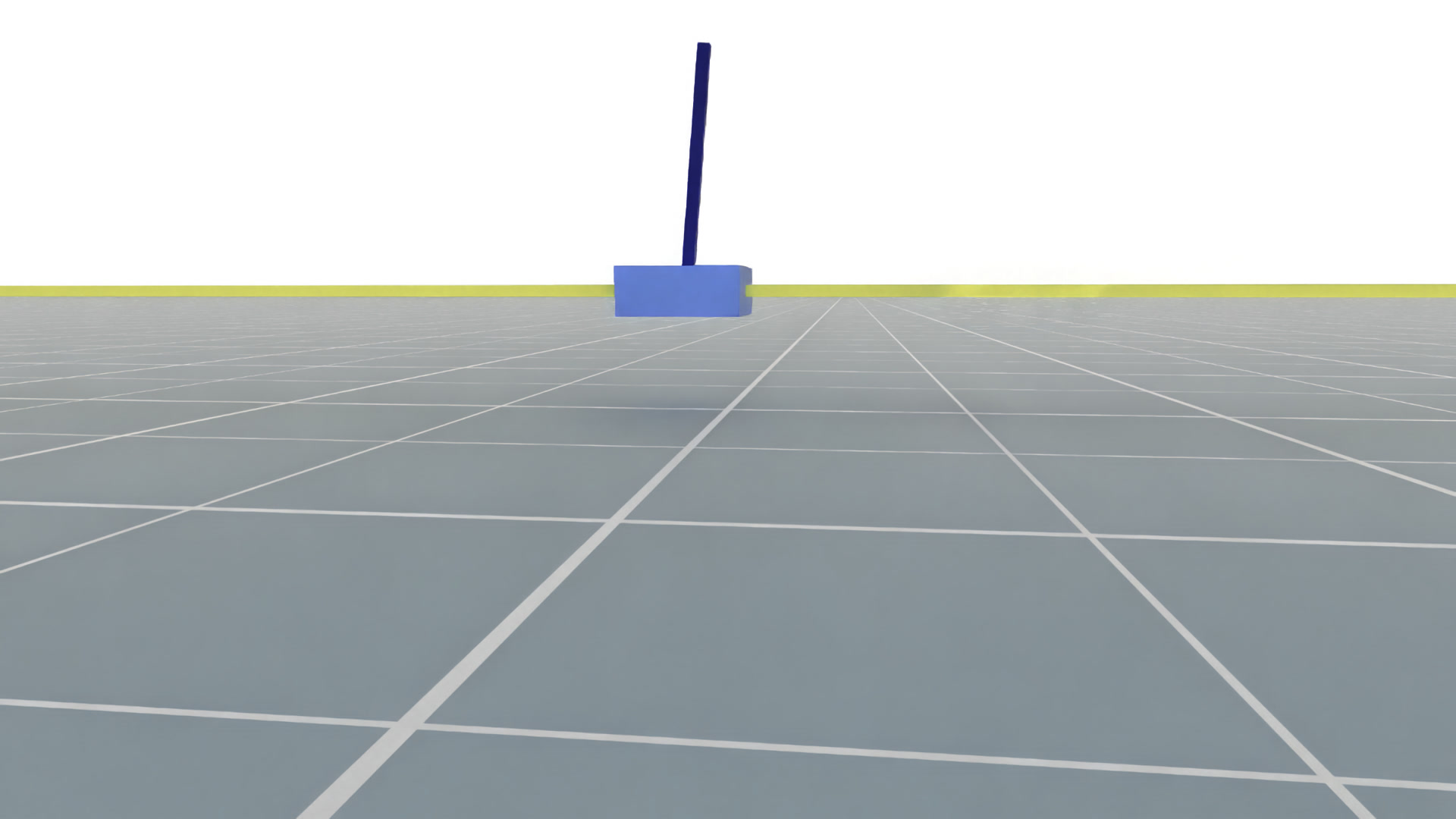
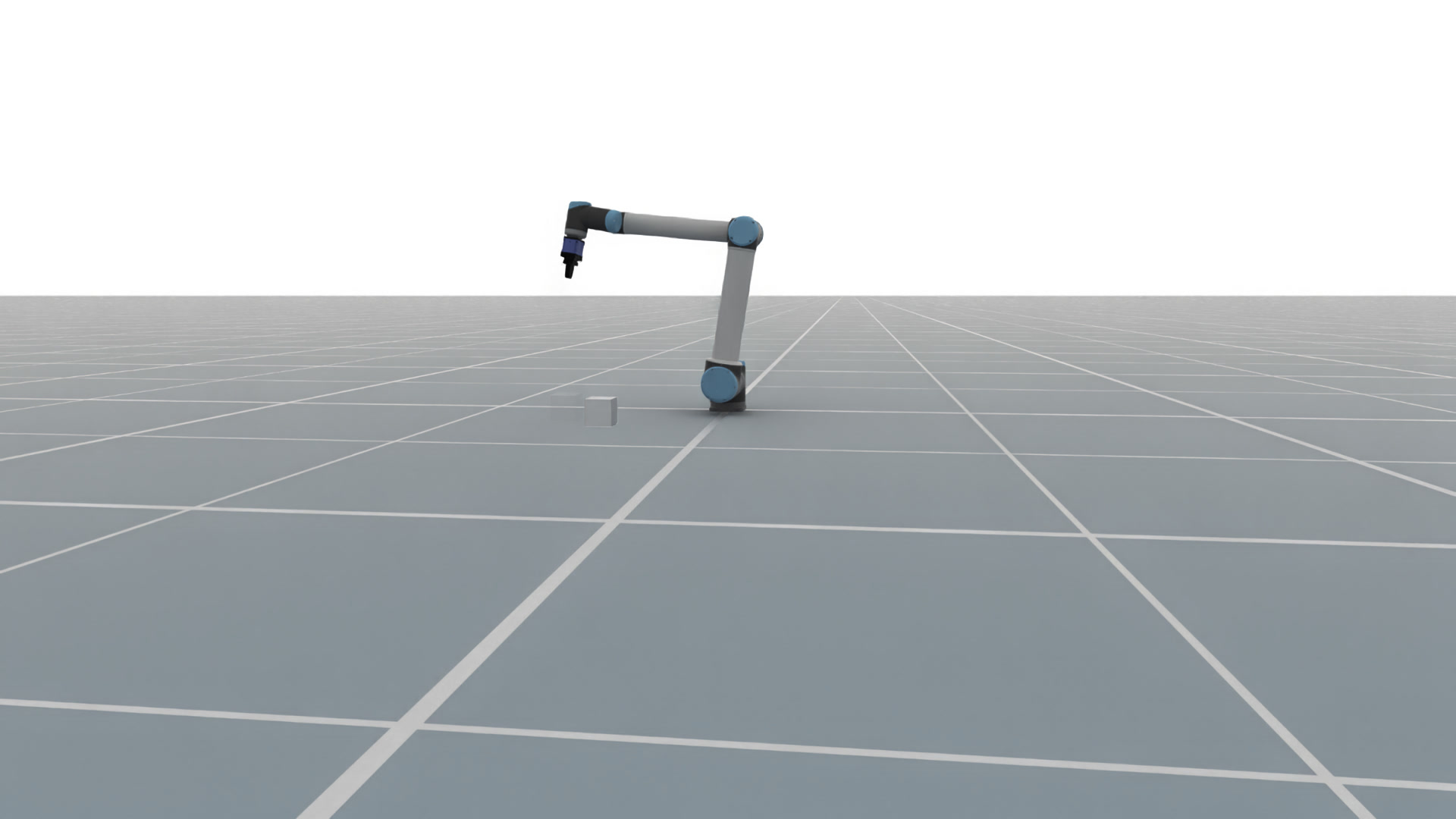
The following frames were captured from Viewer evaluations that loaded trained
checkpoints with --device cuda:0 --sim-device gpu --renderer hybrid:
CartPole policy evaluation |
PushCube policy evaluation |
|---|---|
|
|
For a checkpoint created before run-manifest.json was introduced, provide
its training configuration directly:
embodichain eval-policy \
  --checkpoint /path/to/policy.pt \
  --config /path/to/train.yaml \
  --gym-config /path/to/gym.yaml \
  --viewer
--gym-config can be omitted when the training configuration already refers to
the task configuration.
Execution paths#
        flowchart LR
    Run[Training run] --> Manifest[run-manifest.json]
    Manifest --> Config[Training config]
    Manifest --> Checkpoint[Checkpoint]
    Config --> Runtime[EmbodiChain RL runtime]
    Checkpoint --> Runtime
    Runtime --> Headless[Headless episode evaluation]
    Runtime --> Viewer[DexSim MotionPolicyEvaluator]
    Headless --> Report[evaluation.json]
    Viewer --> Report
    Profile[External Motion Profile] --> Viewer
Headless evaluation calls the existing evaluate_episodes() path. Viewer
evaluation keeps the task’s original observation, action processing, reset,
reward, termination, objects, and sensors:
        sequenceDiagram
    participant Evaluator as MotionPolicyEvaluator
    participant Adapter as EmbodiChainTaskPolicyAdapter
    participant Task as EmbodiChainTaskEnvironment
    participant Policy as EmbodiChain Policy
    participant Env as Original task Environment

    Evaluator->>Task: reset()
    Task->>Env: reset()
    Env-->>Task: observation and task state
    Task-->>Evaluator: EvaluationFrame
    loop Each control step
        Evaluator->>Adapter: infer(frame)
        Adapter->>Policy: deterministic inference
        Policy-->>Adapter: action
        Adapter-->>Evaluator: PolicyOutput
        Evaluator->>Task: step(action)
        Task->>Env: action processing and env.step()
        Env-->>Task: observation, reward, termination and info
        Task-->>Evaluator: EnvironmentStep
    end
Input |
Headless |
Viewer |
|---|---|---|
EmbodiChain lightweight RL environment |
Yes |
— |
EmbodiChain simulator RL environment |
Yes |
Yes |
Registered external Motion Profile |
Yes |
Yes |
Policy reconstruction follows the model definition stored in the training configuration.
Viewer controls#
Key |
Action |
|---|---|
|
Reset the task and camera framing |
|
Change a native velocity command when the task exposes one |
|
Zero a supported velocity command |
|
Print the active velocity key bindings |
|
Switch between tracking and free camera modes when the Environment provides a tracking target |
|
Start or stop recording |
|
Close the Viewer |
While tracking is active, drag with the left mouse button to orbit and use the mouse wheel to zoom.
External policy example#
For ONNX-backed Motion Profiles, install the shared
policy-deploy extra
before evaluation.
For an already-authored DexSim Policy Spec, prefer the native
dexsim policy validate and dexsim policy run commands. EmbodiChain’s
--profile path is intended for provider code that constructs a Policy Spec
from an EmbodiChain checkpoint/configuration and needs the same
evaluation.json reporting as native EmbodiChain policies.
The repository includes a concrete ANYmal-C velocity example under
examples/learning/policy_evaluation/. It prepares a public TorchScript
checkpoint and robot assets, registers an adjacent Motion Profile, and forwards
the remaining arguments to eval-policy.
python examples/learning/policy_evaluation/prepare_resources.py
python examples/learning/policy_evaluation/eval_policy.py \
  --viewer \
  --renderer hybrid \
  --sim-device gpu
Use W/S for vx, A/D for vy, Q/E for yaw, and M to zero the command. See
the example README
for the resource layout, observation construction, action conversion, and
Profile implementation.
This example tracks the robot root in the ground plane. Press T to switch
between tracking and free view.
Evaluation report#
evaluation.json records the selected checkpoint and configs, task and device
information, episode results, and aggregated metrics. Reports are written to
<run>/evaluations/ for a training run and next to an explicit checkpoint by
default. Use --output to select another parent directory.