Franka — seven-DOF bare arms#
FrankaCfg, catalog ID Franka, selects a bare seven-joint arm. Both variants expose only arm;
the default TCP is the flange and no end effector is attached implicitly.
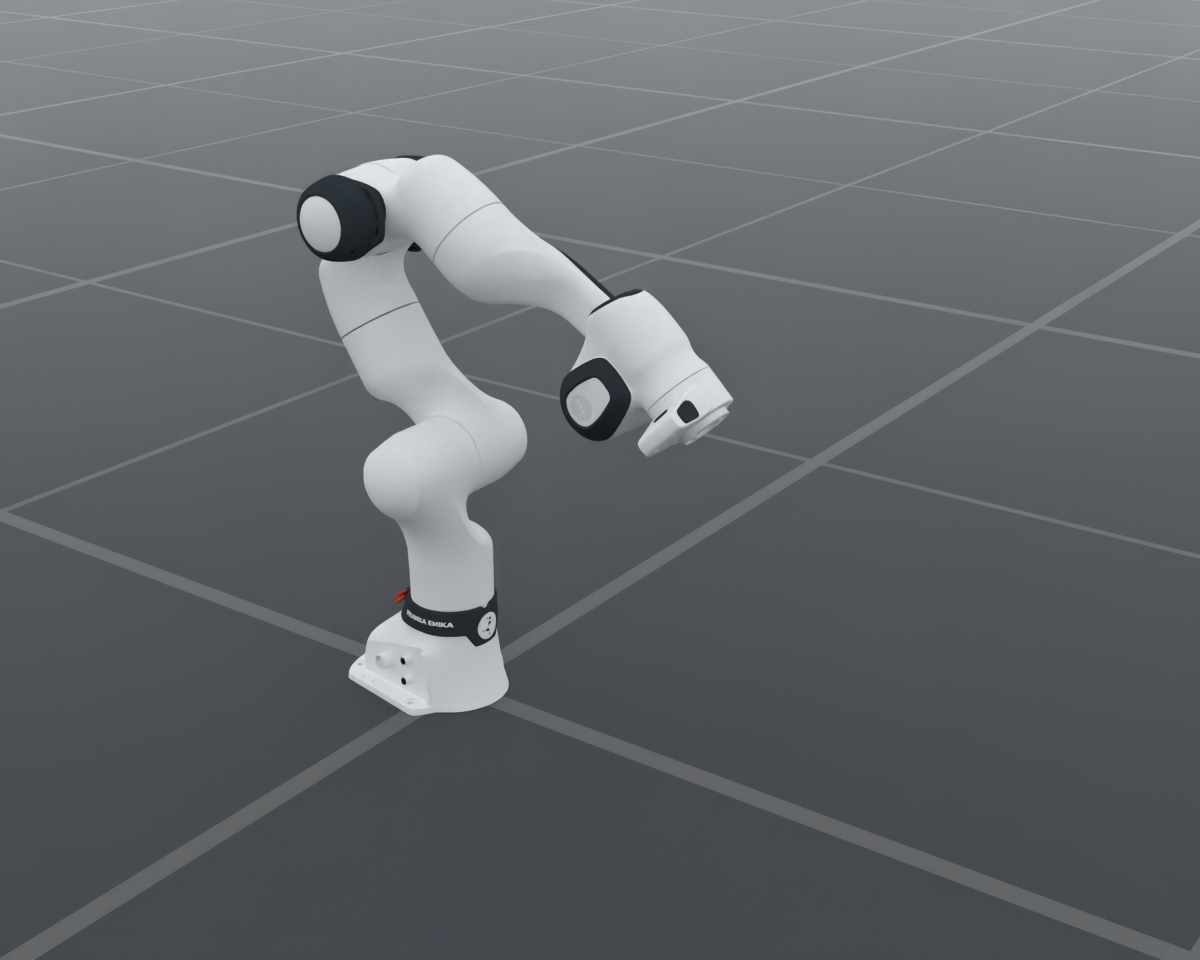
Franka — bare arm (default FR3 model)
The image is a native OfflineRT render of the configured FR3 asset in its
initial joint pose, ending at the mounting flange. No physics steps or tool
attachments are used. The render record
preserves source URDF hashes, named joints, camera and renderer settings.
The original Panda variant is selected separately through arm_model below.
Variant |
Source arm |
Solver |
Flange |
|---|---|---|---|
|
Historical FR3 asset, |
FEP |
|
|
Pinned original Panda, |
Pink |
|
Construction and preview#
from embodichain_robots import FrankaCfg

arm = FrankaCfg.from_dict({})  # FR3 by default
panda_arm = FrankaCfg.from_dict({"arm_model": "panda"})
assert set(arm.control_parts) == {"arm"}
assert len(arm.init_qpos) == 7
Add the selected configuration to SimulationManager with sim.add_robot(cfg=arm).
The catalog and preview CLI use the same configuration:
embodichain preview-robot --robot Franka --variant fr3 --renderer rt
embodichain preview-robot --robot Franka --variant panda --renderer rt
Franka and the historical FrankaPanda entry#
Selection |
Constructed robot |
Tool ownership |
|---|---|---|
|
Seven-joint FR3 arm |
Embodiment or standard RobotCfg overrides |
|
Seven-joint original Panda arm |
Embodiment or standard RobotCfg overrides |
|
Historical FR3 arm, with legacy |
Explicit assembly is also required |
|
FR3 arm plus native Panda Hand |
Component declares hand joints, drives, mount and TCP |
The legacy FrankaPanda name continues to select the historical FR3 asset
family. The original Panda is selected by FrankaCfg with arm_model: panda.
See FrankaPanda and its native-hand setup for the compatibility
constructor and a visual comparison with the explicit hand assembly.
Mounting end effectors#
Use the same standard RobotCfg overrides as UR arms: append a hand URDF
component, declare its control group, drives and initial joints, and set the
flange-to-TCP matrix in solver_cfg.arm.tcp. The component’s transform is
the flange-to-hand mounting transform. The TCP matrix includes that mounting
transform and the tool-local TCP offset once.
The reusable embodiment components provide concrete qualified assemblies:
franka_panda.yamlandfranka_panda_rgb_224.yamlmount the authored FR3 hand as a separate component, preserving its finger joints and contact TCP.franka_panda_robotiq85.yamlmounts the sharedRobotiq_V22F-85 at the explicitly declared 18 mm adapter, with a 150 mm tool-local offset. It owns the six linkage joint declarations, signed limits, tool drives, nominal inertial overlays and solver iteration calibration.
The FR3 hand component Franka/Panda/Fr3HandV1.urdf is derived from the pinned
PandaWithHand.urdf hand subtree. The original file is retained. Link and joint
names, collision geometry and authored inertials are preserved; a sidecar
records the source and derived hashes. The arm and hand URDFs share their
original asset directory so relative mesh paths remain valid.
The Robotiq assembly retains its qualified asset, component order and assembly
name. The separate Robotiq2F85 archive is a different model identity and is
not substituted. Opening conversion remains available from
embodichain_robots.robotiq.two_finger.robotiq85_joint_positions.
Migration#
gripper, gripper_mount_z_m, gripper_mount_yaw_rad and tcp_offset_m are
removed from FrankaCfg; supplying them fails with assembly guidance. Use the
ordinary component and solver fields described above. Tool identity is owned
by the explicitly selected tool asset rather than a second arm selector.
FrankaPandaCfg and catalog ID FrankaPanda remain legacy selectors for the
historical FR3 arm (robot_type: panda). They now also produce a bare arm.
Callers needing fingers must use an explicit embodiment or mount their tool.
Bare dual-arm composition contains fourteen arm joints; finger groups are
added only by a tool-equipped deployment. Official native-hand and PGI
consumers assemble their tools explicitly.
Model-specific Panda inertial overlays remain arm-owned. Tool and contact calibrations are embodiment-owned. Identified inertials, nominal tool values and the explicit 5 g pad assumption establish simulation settings, not hardware dynamics qualification. See the model README and asset provenance for sources.