NeRD: Neural Robot Dynamics#
NeRD predicts articulated robot state changes from a history of states, joint efforts and contact observations. The supported reference systems are contact-free Cartpole and free-base Ant on a static plane. Choose it when the transition depends on recent motion and applied efforts, using a dataset and codec that match the physical system.
The simulation-independent network, codec, trajectory reader and SL recipe live
in embodichain.extensions.models.dynamics.nerd. The learning/nerd example prepares
resources and provides collection, training, export and evaluation commands.
Native simulation deployment is a separate consumer of the model and codec.
Architecture#
NeRD replaces the forward-dynamics and contact solvers in a simulation step with a learned transition. The simulator still computes kinematics and detects contacts. Supplying those quantities in the robot’s frame lets the same robot-specific network operate at different world positions and headings. NeRD project · Authors’ framework diagram
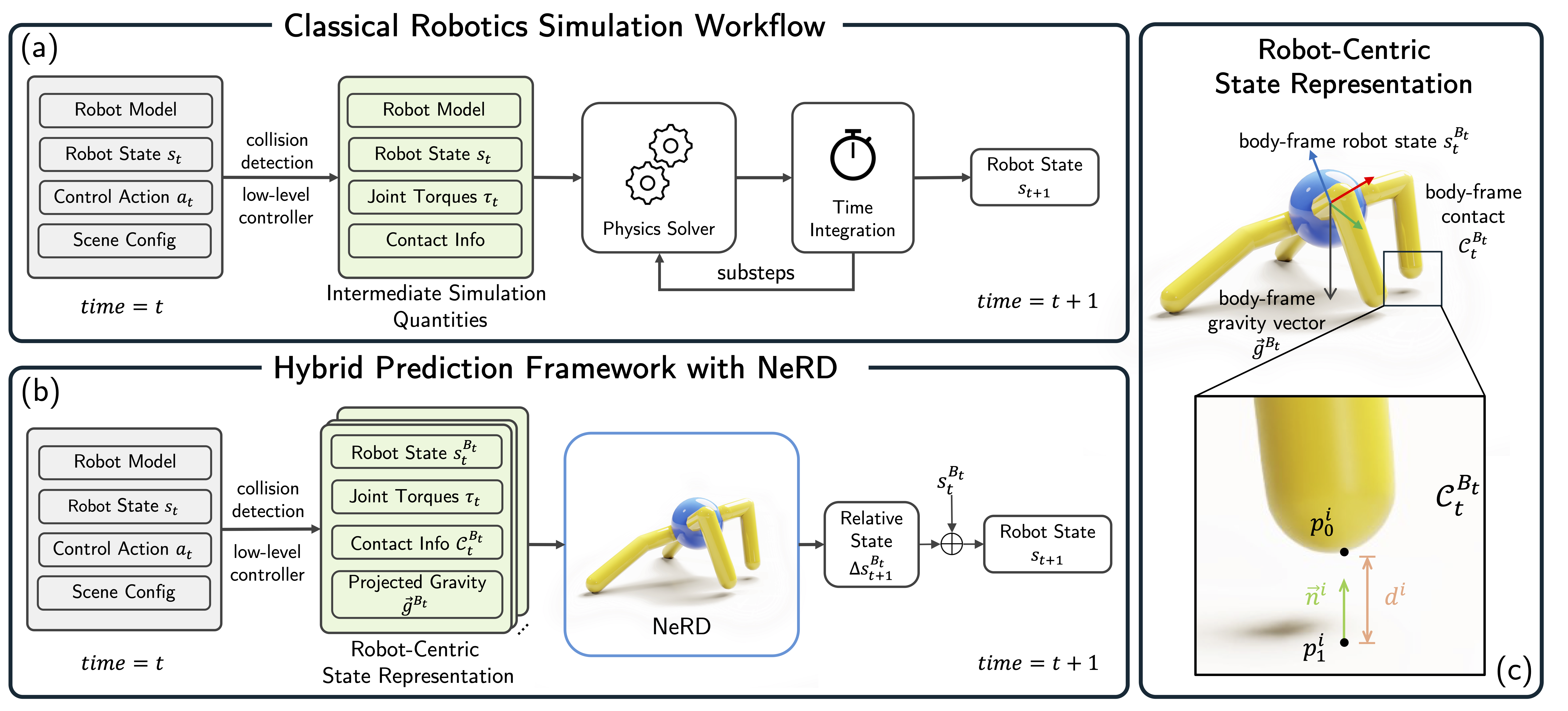
The physical codec converts each observed state and effort into named feature tensors. It expresses Ant state/contact features in the current body frame and converts native center-of-mass velocities to the angular-first spatial-twist convention used by the reference model. Cartpole uses joint coordinates and velocities directly.
        flowchart TB
    accTitle: NeRD articulated robot state transition
    S["Robot state (q, qd)"] --> C["Robot-specific feature encoding"]
    G["Contact geometry when present"] --> C
    C --> H["Normalized feature history"]
    U["Joint efforts"] --> H
    H --> T["Causal Transformer and prediction head"]
    T --> D["Denormalized state change"]
    D --> Q["Apply change to current state"]
    S --> Q
    Q --> NEXT["Next robot state (q, qd)"]
Named features are normalized and concatenated at each history position, then projected into Transformer tokens with learned positional embeddings. Causal attention lets a token use its own inputs and earlier history. The prediction head returns state-change targets in physical units after denormalization.
For Cartpole, the target is joint-position change followed by velocity change:
Here z concatenates normalized features; H is the available history length.
The subtraction ⊖ wraps only configured continuous coordinates, such as
Cartpole’s pole angle. Ant targets contain translation, a relative quaternion,
joint changes and velocity changes expressed in the frame at time t. The codec
reconstructs the next native state; an Ant quaternion target is composed as a rotation.
The timestep and physical identity come from the data/model manifests.
Training minimizes normalized state-change MSE with statistics computed only
from training windows. forward() predicts every token, while evaluate()
selects the final valid token in each history. Both the network and codec retain
input gradients. Use an autograd-enabled context when differentiating through
prediction; the inference example below disables it explicitly.
Inputs and outputs#
Let B be batch size and H the number of history positions. Named network
inputs have shape [B, H, width]:
Feature |
Cartpole width |
Ant width |
|---|---|---|
|
4 |
29 |
|
2 generalized efforts |
8 actuated efforts |
|
Not used |
75: 25 ordered slots × 3 |
|
Not used |
75: 25 ordered slots × 3 |
|
Not used |
25 |
|
Not used |
3 |
Prediction width |
4 |
29 |
The raw codec accepts Cartpole q/qd widths 2/2 or Ant widths 15/14. Ant q
contains xyz, an xyzw quaternion and eight joint coordinates; native qd
contains world COM linear velocity, world angular velocity and joint speeds.
Ant control records have zero free-base effort. The fixed plane-contact slots
are explicit observations; the network does not run collision detection.
model(inputs) returns [B, H, output_dim].
model.evaluate(inputs, valid_lengths) returns [B, 1, output_dim], where
valid_lengths is an int64 [B] tensor. Histories must respect the loaded
model’s feature order and block_size; the shipped recipes use ten-position
windows. Trajectories contain T+1 states and T effort/contact records, and
windows cannot cross trajectory or train/validation/test boundaries.
Examples#
Prepare the published weights and trajectories, evaluate transitions, or
train a new model with the Cartpole and Ant examples.
Use the installed EmbodiChain package with PyTorch on CPU or CUDA. For a
source checkout, install it with python -m pip install -e ..
Prepare and evaluate#
These commands also work from an installed wheel outside the checkout:
embodichain run-example learning/nerd prepare --robot cartpole --resource-root ./outputs/nerd-resources
embodichain run-example learning/nerd eval --robot cartpole --resource-root ./outputs/nerd-resources --device cpu
Use --robot ant for Ant. prepare verifies pinned manifests, shards, weights
and reference asset hashes. Add --assets-only to prepare only teacher assets,
or --local-files-only to require an existing verified cache without network
access. Without --resource-root, the showcase uses
EMBODICHAIN_NERD_RESOURCE_ROOT, otherwise the cache under XDG_CACHE_HOME or
~/.cache/embodichain/examples/nerd. Evaluation writes
outputs/nerd/<robot>/offline.json unless overridden with --output.
Offline evaluation measures held-out transitions and does not start a simulator.
It does not establish accumulated rollout accuracy. Published Scene-generated
trajectories retain their original physical identity; the independent direct
Newton collector uses nerd-direct-newton-builder-v1. A shared schema or profile
name does not make different solvers, versions or construction paths identical.
Use measured windows in PyTorch#
This is the offline network/codec path. Online model rollout and native solver deployment use the separate execution paths described below.
After preparing Cartpole resources, read one matching held-out window:
from pathlib import Path

import torch

from embodichain.extensions.models.dynamics.nerd import NeRDStateCodec, load_model
from embodichain.extensions.models.dynamics.nerd.data import DynamicsWindowDataset
from embodichain.extensions.models.dynamics.nerd.integration import encode_batch

root = Path("outputs/nerd-resources")
model, manifest = load_model(
    root / "models/neural_dynamics/nerd/cartpole/v1",
    device="cpu",
)
codec = NeRDStateCodec(**manifest["codec"])
dataset = DynamicsWindowDataset(
    root / "datasets/neural_dynamics/nerd/cartpole/v1",
    split="test",
    history_length=model.cfg.history_length,
    verify=True,
)
try:
    window = dataset.get_batch([0])
    inputs, targets, valid = encode_batch(window, codec, "cpu")
    with torch.inference_mode():
        delta = model.evaluate(inputs, valid.sum(dim=-1).long())
        # A full window has H input states and one final target state.
        next_q, next_qd = codec.decode(
            window["states"]["q"][:, -2],
            window["states"]["qd"][:, -2],
            delta[:, 0],
        )
    print(delta.shape, next_q.shape, next_qd.shape)  # [1, 1, 4], [1, 2], [1, 2]
finally:
    dataset.close()
The prepared dataset/model pair provides the matching codec, timestep and
physical identity. When supplying your own data, verify those contracts before
prediction, as the example’s eval command does. encode_batch returns named
features, relative targets and a validity mask. codec.decode() reconstructs
native q/qd from the current state and its predicted change.
Online rollout, learning-env and native deployment#
These are separate consumers of the same NeRDTransition:
Execution path |
Entry and owner |
Gradient/reset boundary |
|---|---|---|
Online tensor rollout |
|
State/history are explicit; the caller owns detach and reset |
Policy learning |
|
Environment owns reward, terminal observations, row reset and |
Native scene inference |
|
SDK owns buffers/step/reset/close; native prediction uses |
Online step computes current-state FK/contact features through its injected
NeRDGeometry, appends history, predicts and decodes the next state. Offline
SL may still encode measured contacts as above. Ant transition effort has eight
actuated columns; the native example helper accepts fourteen generalized
columns with the first six zero. Cartpole uses two generalized columns.
For policy learning, set trainer.learning_env.cfg.checkpoint in the supplied
agent recipe to your matching export and run from the source repository root:
embodichain run-example learning/nerd train-policy --config examples/learning/nerd/configs/cartpole/agents/apg.nerd.yaml
The factory builds an FK-only reference model, without a World, Scene or solver.
RWM uses the same learning-env/trainer protocols. The existing Warp
DifferentiableEnv retains its kinematic execution path. Geometry caches only
fixed tensors; full resets allocate independent episode storage, partial resets
preserve peers, and boolean contact switches have piecewise gradients.
The native solver quickstart
provides both the model-only preparation code and a complete two-robot native
step/readback/reset/close example. It uses the existing example-owned
DynamicsSimulation helper and also shows the direct Provider and registered
nerd configuration forms. It is separate from policy training and offline
evaluation. Use one prediction per export interval, num_substeps=1 and
use_cuda_graph=False; finalized geometry, COM conventions, ordered contacts,
gravity and physical signatures must match the export.
The execution record
records published-weight Cartpole/Ant runs with two environments and sixty
native steps each, followed by reset/history replay, on the specified CUDA
runtime. No desktop viewer or NeRD rendered output was qualified. The Newton
FK gradient adapter is private; reusable tensor FK/IK remains in
compute.kinematics and learning.layers.
Comparison videos#
These recordings compare the learned NeRD transition with its matching Newton Featherstone solver. Each video shows passive motion, shared random efforts, and a PD controller. Passive and random-effort comparisons use the same initial state and applied effort sequence. In the PD segment, each simulator computes feedback from its own state, so the comparison shows closed-loop behavior.
Download the Cartpole video or Ant video. The recordings visualize the released reference models; they are not a claim of paper-level accuracy or equivalent behavior in arbitrary robot scenes.
Training and evaluation#
Train, recover and export#
After preparation, train through the default common SL recipe:
embodichain run-example learning/nerd train --robot cartpole --resource-root ./outputs/nerd-resources --device cuda:0 --output-dir ./outputs/nerd/cartpole/train
embodichain run-example learning/nerd export --checkpoint ./outputs/nerd/cartpole/train/last.pt --output ./outputs/nerd/cartpole/export
embodichain run-example learning/nerd eval --robot cartpole --resource-root ./outputs/nerd-resources --device cpu --model ./outputs/nerd/cartpole/export --output ./outputs/nerd/cartpole/trained-eval.json
--device cpu is also supported for training. The shipped sl.train.yaml
configures 1,000 updates; this bounded example does not claim full convergence.
The default output is outputs/nerd/<robot>/train. Resume with the same recipe
and resources:
embodichain run-example learning/nerd train --robot cartpole --resource-root ./outputs/nerd-resources --device cuda:0 --output-dir ./outputs/nerd/cartpole/train --resume ./outputs/nerd/cartpole/train/last.pt
Choose an artifact-free output for a new run. Recovery checks data, recipe, feature order and run identity. Different or newer metric history is preserved and requires a fresh destination. The final SL checkpoint is not a claim of validation-selected accuracy.
The generic entry point accepts the same installable factory without example
bootstrap. Copy the Cartpole recipe
or Ant recipe.
Set data.path to the prepared dataset and trainer.output_dir to a fresh
output, then run:
embodichain train-sl --config /path/to/recipe.yaml
embodichain train-sl --config /path/to/recipe.yaml --resume /path/to/train/last.pt
Relative paths in a common SL recipe resolve from the working directory. Its installable factory is:
embodichain.extensions.models.dynamics.nerd.sl_recipe:build_supervised_trainer
Export accepts both SL checkpoints and historical NeRD checkpoints and preserves floating dtype, normalization, ordered features and attention policy. Export destinations must be new directories.
Teacher collection and historical experiments#
Prepare reference assets before invoking the independent collector:
embodichain run-example learning/nerd prepare --robot cartpole --resource-root ./outputs/nerd-resources --assets-only
embodichain run-example learning/nerd generate --robot cartpole --resource-root ./outputs/nerd-resources --device cpu --output-dir ./outputs/nerd/cartpole/generated
The default collection preset is a bounded smoke workflow. Generation uses
Newton’s built-in analytical solvers without DexSim’s custom solver/Scene
extension. Its manifest commits the candidate cursor and rejection evidence
with shards. Rejection-only progress preserves data identity; legacy sidecars
remain readable, but resuming requires matching collector source and physical
identity. Add generate --resume with the same configuration and output to
continue collection. For the larger collection and historical training presets,
see the Cartpole configurations
and Ant configurations.
The smoke collector and the default 1,000-update SL run exercise the workflow;
full collection and paper-reproduction budgets are specified separately there.
Explicit dynamics.train.*.yaml configurations in the showcase select the
historical trainer. It retains its NeRD checkpoint format and comparison
sampling/scheduling, including historical fine-tuning and shared sample-order
options. Its best.pt is a model-only selected snapshot for export; last.pt
is resumable and retains the selected best weights. These options are separate
from default SL training. See the showcase’s research protocol
for frozen source revisions, paired-seed gates and historical evidence limits.
Moving code or rerunning a smoke does not rerun those frozen experiments.
References#
Jie Xu, Eric Heiden, Iretiayo Akinola, Dieter Fox, Miles Macklin, and Yashraj Narang (2025). Neural Robot Dynamics. Conference on Robot Learning. arXiv:2508.15755
@inproceedings{xu2025neuralrobotdynamics,
  title = {Neural Robot Dynamics},
  author = {Xu, Jie and Heiden, Eric and Akinola, Iretiayo and Fox, Dieter and
            Macklin, Miles and Narang, Yashraj},
  booktitle = {Conference on Robot Learning},
  year = {2025},
  eprint = {2508.15755},
  archivePrefix = {arXiv},
  primaryClass = {cs.RO},
  url = {https://arxiv.org/abs/2508.15755}
}
Implementation and further reading#
Public API: network, codec, trajectory windows, objectives and trainer factory.
Historical experiments, frozen sources and acceptance criteria are described in the research protocol.
Pinned resources#
The showcase prepares these resources at fixed revisions:
Resource |
Repository |
Revision |
|---|---|---|
Dataset |
|
|
Portable model |
|
|
Raw teacher assets |
|
Datasets and models use neural_dynamics/nerd/<robot>/v1, where <robot> is
cartpole or ant. Raw assets use demo/nerd/reference_assets/v1; the verified
archive includes the URDF/XML, attribution and license. These downloaded
payloads are stored outside Git and the wheel. The model implementation and its
third-party license ship in the main EmbodiChain wheel with the same version.
Dataset manifests publish trajectory-level train/validation/test splits and
physical provenance. Trajectories have T+1 states and T effort/contact inputs;
windows cannot cross trajectories or splits. Portable models contain
weights.pt and manifest.json, with the network, normalization, codec,
timestep and physical identity. They are inference exports, not resumable
training checkpoints. Dataset/model cards describe dependency and evaluation
limits; long-horizon Ant predictions can drift.