YAM dual arms#
embodichain.extensions.robots.YamI2rtCfg configures the converted I2RT YAM dual-arm
assembly. Its implementation and asset definition live together in
embodichain.extensions.robots.i2rt.yam; the robot catalog ID is YamI2rt.
Catalog listing reads metadata without loading the model or downloading assets.
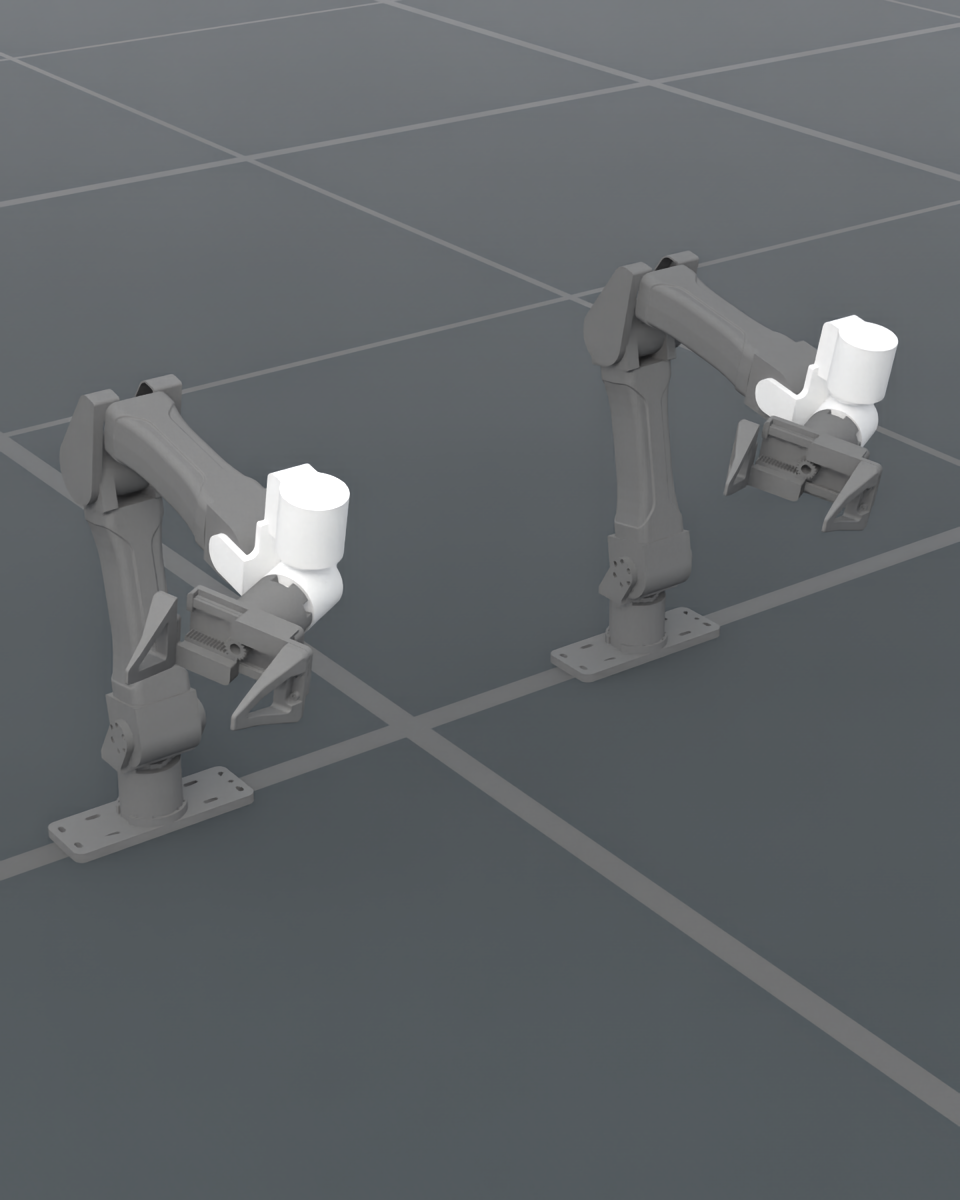
YAM dual-arm assembly captured in DexSim OfflineRT.#
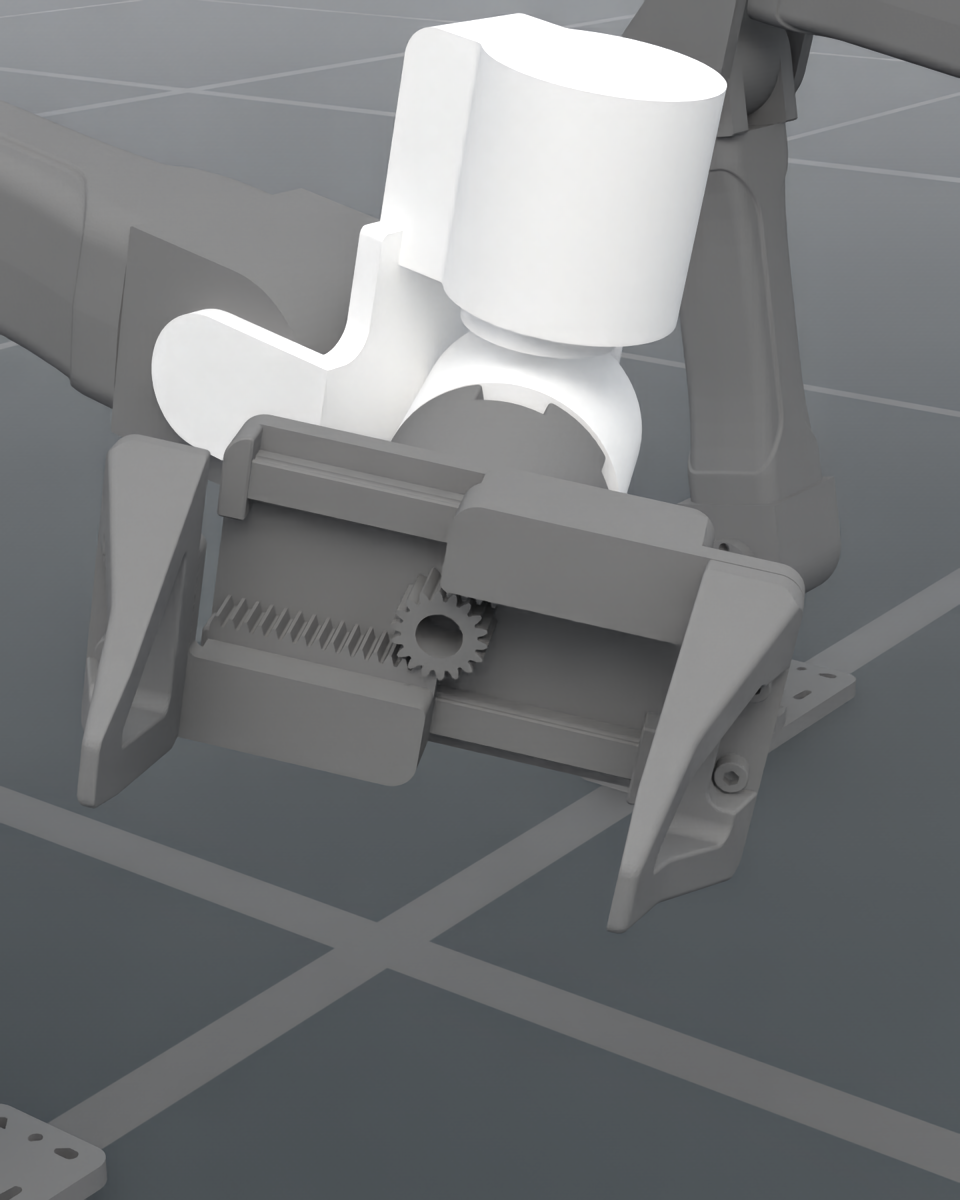
The captures use the default joint pose and source materials, with the bases placed at ground level and a soft rectangular key light. See the right gripper close-up and the render records for the assembly and gripper.
Construction and control#
from embodichain.robot_registry import resolve_robot_cfg
from embodichain.extensions.robots import YamI2rtCfg

cfg = resolve_robot_cfg("YamI2rt")
restored = YamI2rtCfg.from_dict(cfg.to_dict())
robot = sim.add_robot(cfg=restored)
The converted asset contains 16 independent controlled joints. Both fingers in each hand are independently actuated; no mimic relation is added.
Control part |
Source joints |
Coordinates |
|---|---|---|
|
|
radians |
|
|
radians |
|
|
metres |
|
|
metres |
build_pk_serial_chain() returns six-joint chains for right_arm and
left_arm, rooted at <side>_base and ending at <side>_tcp. Both the
simulation component and the chains use the same URDF. Each arm defaults to
PytorchSolverCfg; the TCP is the converted source grasp-site frame.
The ready pose, initial world placement, drive gains and collision offsets are
simulation defaults inherited from the reference assembly, not verified hardware
calibration. Override them through ordinary RobotCfg fields for another scene.
The preset uses the shared backend defaults; task-specific Newton gravity
compensation and high-friction contact settings belong to consuming deployments.
Published assets and offline use#
embodichain data download --name YamI2rt
embodichain preview-robot --robot YamI2rt
YamI2rt downloads the published robot_assets/YamI2rtV1.zip from
DexForceAI/embodichain_data
through the configured download prefix, with the official Hugging Face dataset
as fallback. The archive MD5 is 23601ea820ff3e6260336c4962ef01a5; it includes
the source MJCF, converted URDF, visual/collision meshes and provenance.
get_data_path("YamI2rt/yam_i2rt.urdf") reuses the configured data cache. An
explicit fpath selects a prepared local URDF for simulation and kinematics:
cfg = YamI2rtCfg.from_dict({"fpath": "/path/to/YamI2rt/yam_i2rt.urdf"})
The optional source-regeneration script verifies pinned source and generated file hashes before installing a bundle. Mesh-conversion dependencies are needed only for regeneration:
python -m pip install coacd==1.0.14 trimesh==4.12.2 scipy==1.18.1
python scripts/tools/prepare_yam_i2rt_assets.py \
  --archive /path/outside/asset-root/YamI2rtV1.zip
--source-dir selects the pinned offline source directory, and --output
selects the prepared asset directory. Model files and ZIP archives are
distributed separately from the source repository and Python wheel.
Source and license#
The source is assets/embodiments/yam_i2rt/ at RoboSimStudio commit
73739abe212f963e8a9f5862b27bca370df091a7.
Its license and attribution identify the YAM arm and linear_4310 gripper as
I2RT Robotics assets under MIT. Conversion adds named TCP frames and decomposed
fingertip collision meshes. The archive retains LICENSE, NOTICE and
PROVENANCE.json; the repository preserves the model notice and MIT text.