ACT: Action Chunking with Transformers#
ACT predicts a sequence of future actions from the current observation. The original ALOHA policy used multiple camera views and both arms’ joint positions to imitate bimanual demonstrations. EmbodiChain uses LeRobot ACT with one camera and a Franka arm for visual PushCube. ALOHA project
Architecture#
ACT trains a conditional variational autoencoder (CVAE). During training, an encoder infers a style latent from the demonstrated action chunk and current joint positions. A ResNet extracts spatial features from each view. A Transformer fuses those features with the joints and latent, then decodes one learned query per future step. Authors’ architecture diagram
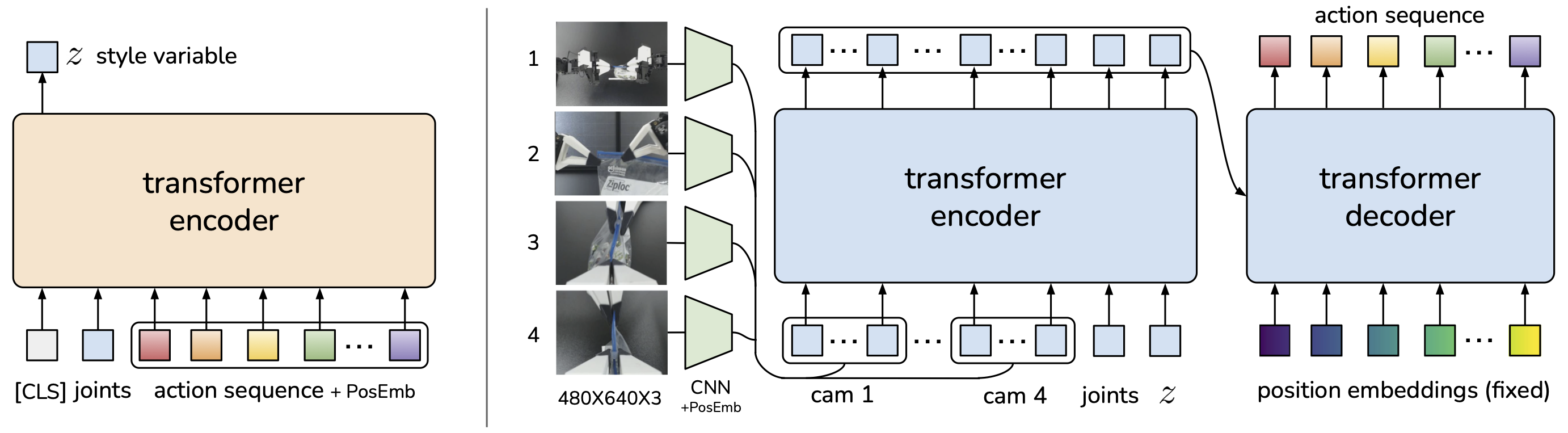
        flowchart TB
    accTitle: ACT action chunk prediction
    DEMO["Joints and demonstration chunk"] --> VAE["CVAE encoder (training)"]
    VAE --> Z["Style latent (zero at inference)"]
    Z --> ENC["Transformer encoder"]
    OBS["Camera views and joint positions"] -->|images| CNN["ResNet-18"]
    CNN --> ENC
    OBS -->|joints| ENC
    ENC --> DEC["Transformer decoder with K action queries"]
    DEC --> CHUNK["K future actions"]
The PushCube recipe uses ResNet-18 and trains with an L1 loss on valid action targets plus a KL penalty that draws the latent distribution toward a standard Gaussian. At inference the policy uses the prior mean (zero). It predicts a fresh chunk at each control step and averages predictions from overlapping chunks for the same instant to choose the command.
Inputs and outputs#
Stage in the PushCube example |
Shape |
Meaning |
|---|---|---|
Camera input |
|
Current uint8 RGB frame |
State input |
|
Measured positions of seven arm joints and two finger joints |
Model prediction |
|
A 30-step chunk in the learned action space |
|
|
Seven absolute arm joint targets and one normalized parallel-gripper command for the current step |
Using a trained policy#
Use the Python 3.12 environment with LeRobot 0.6.1 and the native camera
renderer. Load the exported pretrained_model directory together with its
embodichain_act.json manifest through load_act_policy. The adapter applies
the saved processors and returns physical commands. Call reset() after
every environment reset to clear the ensemble’s action history.
Examples#
Collect successful demonstrations, train the policy and evaluate a checkpoint on held-out PushCube scenes using the visual PushCube example. For the loader and training configuration, see the ACT API.
References#
Tony Z. Zhao, Vikash Kumar, Sergey Levine, and Chelsea Finn (2023). Learning Fine-Grained Bimanual Manipulation with Low-Cost Hardware. Robotics: Science and Systems XIX. Proceedings and paper
@inproceedings{Zhao-RSS-23,
  author = {Zhao, Tony Z. and Kumar, Vikash and Levine, Sergey and Finn, Chelsea},
  title = {Learning Fine-Grained Bimanual Manipulation with Low-Cost Hardware},
  booktitle = {Robotics: Science and Systems XIX},
  year = {2023},
  doi = {10.15607/RSS.2023.XIX.016}
}